
Offloading cognitive tasks is normal. But in the age of AI, the research is clear: we need guardrails to keep our judgement sharp.
Offloading Was Never the Problem
All my life I've watched tools arrive that help us and quietly let a skill atrophy. I remember buying maps so I could navigate.
I remember looking up where to go and the best route before a trip, then periodically stopping, pulling out the next map if it was a long trip, remembering the next stretch and driving on.
It also meant that I had a whole bunch of directions in my head! I had a mental model of the city I was living in, the region and generally a good grasp on where I was and where I needed to go.
The invention of navigation systems in the car made that redundant. Soon I realised, I started to forget. I stopped planning a trip and just went where I was told.
It started with forgetting phone numbers because I could save them in my palm and later my phone, and numerous other inventions made my life easier at the cost of my skills. The skill of memorising information transferred to remembering where the information is stored and how I can access it. Psychologists have a name for this. Back in 2011, Sparrow and colleagues found that when we expect to look something up later, we remember the information itself less well, and remember where to find it instead. They called it the Google effect.
As the world got more complex, faster and faster, the need to use tools, such as calculators, calendar and phones for navigation felt justified and necessary. The cognitive offloading frees working memory which I definitely needed while I was learning to program computers and play video games.
But AI feels a bit different, doesn't it?
I've been thinking about this a lot lately. While all the technologies before made me lose memory, encoding and recall abilities, AI threatens skills that are much more valuable to me. It threatens judgement, reasoning, synthesis and creativity.
This scares me.
The Cost Shows Up When AI Does the Thinking
I noticed it most with coding. Using AI to code for me feels like magic. I love it! Instead of doing the hard work, writing the tests, solving all the puzzles, researching and architecting, I just say what I want.
I got addicted when the first coding assistants came out. I also lost my ability to just hack something together on my own. For coding that's ok. It's not my job anymore. I'm willing to pay the price. I do miss solving puzzles and cracking my head to come up with a solution to a particularly interesting challenge. On the other hand, I love just typing a sentence and have an automation coded that removes an annoying manual task.
I feel different about art and writing though.
I now write for a living. I pursue art for my pleasure.
I don't want AI to create art for me. That defeats the purpose! Creating art is a journey that involves coming up with an idea and finding a way to express it. It means developing a sense of design and seeing beauty. Training the hand and working on skills every day.
Writing is similar. I used to write and publish every day. For the past year, I wrote only for myself. Every day I write my morning pages, by hand with my beloved fountain pen.
At work it gets tricky. Writing for work means research, interviewing people, coming up with the story and then writing it down.
I'm aware there are two sides to this. The quality of the output and my skills as a writer. In this article I want to focus on my skills.
I'm concerned that if I outsource all of that work to AI, it would mean that for a big part of my day, I would have less mental engagement. In a 2025 MIT Media Lab study, writers using an AI assistant showed up to 55% lower task-related brain connectivity than those writing unaided, and the under-engagement lingered even after they went back to writing on their own. It's an early but striking finding.
A separate 2025 study by Gerlich, of 666 people, found a strong negative link between frequent AI use and critical-thinking scores.
I also notice that if I use AI to generate content (i.e. reporting and things that don't require critical thinking), I'm less engaged with it. I have to force myself to read and verify it, but I don't care as much. I think that is a normal consequence. I care more about a cake I baked than one I bought.
For me this means I consciously choose what I use AI for. The split between the tasks I do and the tasks AI does is the thing that matters. As I'm using AI heavily, I want to make sure I still do the verifying, editing and storytelling to keep my critical and creative thinking skills sharp.
Use AI as a Thinking Gym, Not a Crutch
After a few years of using AI at work, I think I found a way that works for me.
Let's take this article as an example.
I had AI do the research. It found several studies that are relevant to the topic of this article. It downloaded the papers and extracted insights. I read the papers before I read the insights from AI and I highlighted relevant parts. I summed up the key points. Only then did I compare it with the AI output.
Then I wrote the first draft. I'm writing on an e-ink device. I use this to avoid distractions and also the temptation to use AI!
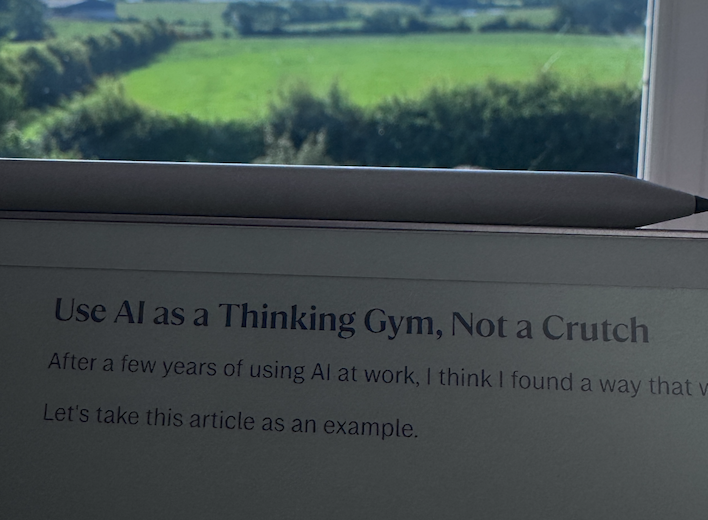
Then I co-edit the first draft. English is not my native language, so even if I am quite reasonable at using it, I still like the comfort of knowing a spell checker has been used and some of my 'weird ways to express myself' are smoothed over.
What I do by instinct, the research backs up: how you use AI matters more than whether you use it.
In a 2025 Wharton study of around 1,000 students, plain ChatGPT lifted practice scores by 48% — but once it was taken away, those students scored 17% worse than peers who'd never used AI. A guard-railed tutor that gave hints instead of answers held its ground: those students tested on par with the no-AI group. And a 2025 Microsoft and Carnegie Mellon survey found that confidence in the AI lowered critical thinking, while confidence in yourself raised it.
For me this means, anything I start to work on, I work on it first without AI. Most likely with pen and paper as I do my best thinking that way. Then I let AI fine-tune the results by researching counter points and papers. Then I craft the story and hand over back to AI to tidy it up.
AI should be the test suite or peer reviewer, not the person secretly writing the whole feature.
Your Action Items
Do you want to be more aware of how you use AI?
- Before opening AI, write your own rough answer in five bullets. Do it badly if you have to. The point is to make your brain take the first rep.
- Ask AI for hints, objections, and gaps, not a finished answer. Try: "What am I missing?" or "Where is this weak?"
- Pick one AI-assisted output today and verify it before you use it. Check a source, run the logic yourself, or explain the answer in your own words.
References
Bastani, H., Bastani, O., Sungu, A., Ge, H., Kabakcı, Ö., & Mariman, R. (2025). Generative AI without guardrails can harm learning: Evidence from high school mathematics. Proceedings of the National Academy of Sciences, 122(26), Article e2422633122. https://doi.org/10.1073/pnas.2422633122
Gerlich, M. (2025). AI tools in society: Impacts on cognitive offloading and the future of critical thinking. Societies, 15(1), Article 6. https://doi.org/10.3390/soc15010006
Kosmyna, N., Hauptmann, E., Yuan, Y. T., Situ, J., Liao, X.-H., Beresnitzky, A. V., Braunstein, I., & Maes, P. (2025). Your brain on ChatGPT: Accumulation of cognitive debt when using an AI assistant for essay writing task. arXiv. https://arxiv.org/abs/2506.08872
Lee, H.-P., Sarkar, A., Tankelevitch, L., Drosos, I., Rintel, S., Banks, R., & Wilson, N. (2025). The impact of generative AI on critical thinking: Self-reported reductions in cognitive effort and confidence effects from a survey of knowledge workers. In Proceedings of the 2025 CHI Conference on Human Factors in Computing Systems (Article 1121). Association for Computing Machinery. https://doi.org/10.1145/3706598.3713778
Sparrow, B., Liu, J., & Wegner, D. M. (2011). Google effects on memory: Cognitive consequences of having information at our fingertips. Science, 333(6043), 776–778. https://doi.org/10.1126/science.1207745